
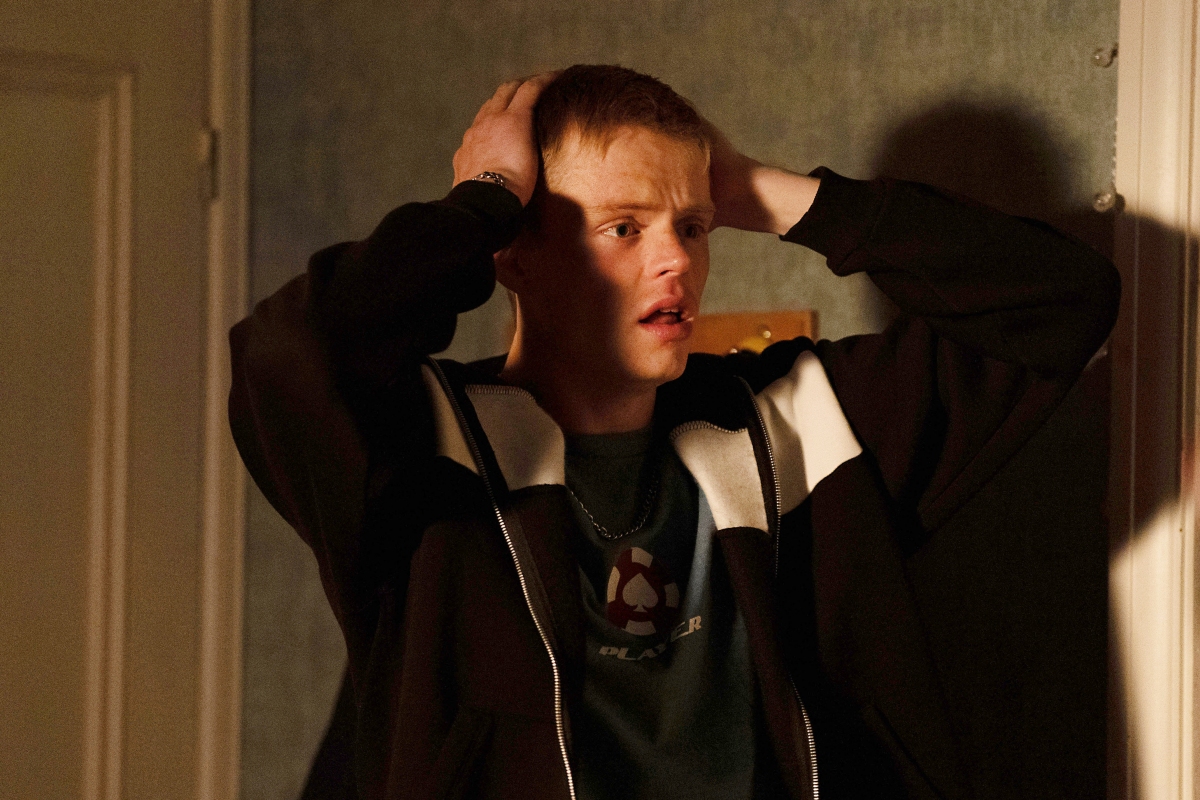
Fourth Time Lucky
Britain’s cheeriest soap Eastenders (BBC) gave us a new bisexual bad boy, who graces this BCN cover. The character of Oscar Branning returned with Pierre Moullier being the fourth actor to play the part. No wonder most of the Square don’t recognise him when he walks in.
Oscar hasn’t been in the show since 2017, and we quickly learn he has been imprisoned for petty crime as he rejoins the plot fresh out of youth detention.
Reaching hard into the bag of bisexual stereotypes, Oscar is an incorrigible – and often inappropriate – flirt, making much of his sister’s boyfriend being attractive while asking her for favours. He’s also the untrustworthy bi, and the self-serving bi – feigning injury to extract money from Eastenders relic Ian Beale and lying about his situation to people around him. The icing on the cliche cake is that he’s bringing trouble wherever he goes – with a standing feud that has seen an attempt to firebomb his mum’s house by a rival.
Eastenders might have kicked the year off with a bi marriage – now it looks like it is heading back down the road of the bisexual heartbreaker. Put the kettle on ready for the next installment.
Endless Fun
The Sandman returned for a second season on Netflix despite the cloud over author Neil Gaiman. It’s landing in lumps of a third of a season at a time, so at the time of writing only the first few episodes are here, but by the time this is in print they’ll all be out.
It is deliciously true to the artistic style of the comics. The bisexuality, at least among the Endless, is hard to pin down but at the least Desire (Mason Alexander Park, fresh from playing non-binary character Ian in the Quantum Leap reboot) inspires it in so many mortals they pass. Among the bi mortals Johanna (Jenna Coleman) will be returning later in season 2.
In the first part, Lucifer has had it with ruling hell, and manages to palm it off to Morpheus – who becomes the centre of the story. Cue a bidding war for who will be the new ruler, as almost every kind of immortal would love to rule the place. And that is as far as we have got at the time of writing.
Roaring Twenties
 Dope Girls (BBC) provides a lusty dive into drugs and (often queer) sexuality in Soho a century ago, as men returned from war in Europe.
The Spanish Flu pandemic rages in the background and feels terribly now as one woman archly observes: “They are bundling bodies into mass graves. Positively medieval. If the foreigners had better hygiene it mightn’t be necessary.”
Between war and disease everyone has lost a sibling, a parent, a child, and so distraction with sex and drugs has some fair appeal. It’s based on a book which in turn was about real people’s lives, but seems to have been fictionalised a long way from there for plot thrills.
At home, the women police officers were still something of a novelty – the first women to have the power to arrest someone gained that authority during the war. Violet is an apparently-bisexual woman (given the era, no-one uses such words) who enrolls as a copper but goes under cover in the flourishing underworld of drink and drugs. She says she’s doing it to help women in peril, but is willing to make claims about sexual advances from other women to advance her career over theirs.
Is her relationship with Sarah a lie? And can she trust Sergeant Turner, her manipulative and intimidating boss.
Poly Rep
Next a shout-out for a poly relationship that is just incidental to the wider plot in Apple+ TV’s Murderbot. Sabrina Wu, Noma Dumezweni and David Dastmalchian play Pin-Lee, Ayda and Gurathin.
The title explains enough of the plot: a human-like security robot overrides its programming and starts thinking how much better everything would be if it just killed the humans. Whether or not they’re in a somewhat unhealthy-looking throuple. Which is equality of a sort.