
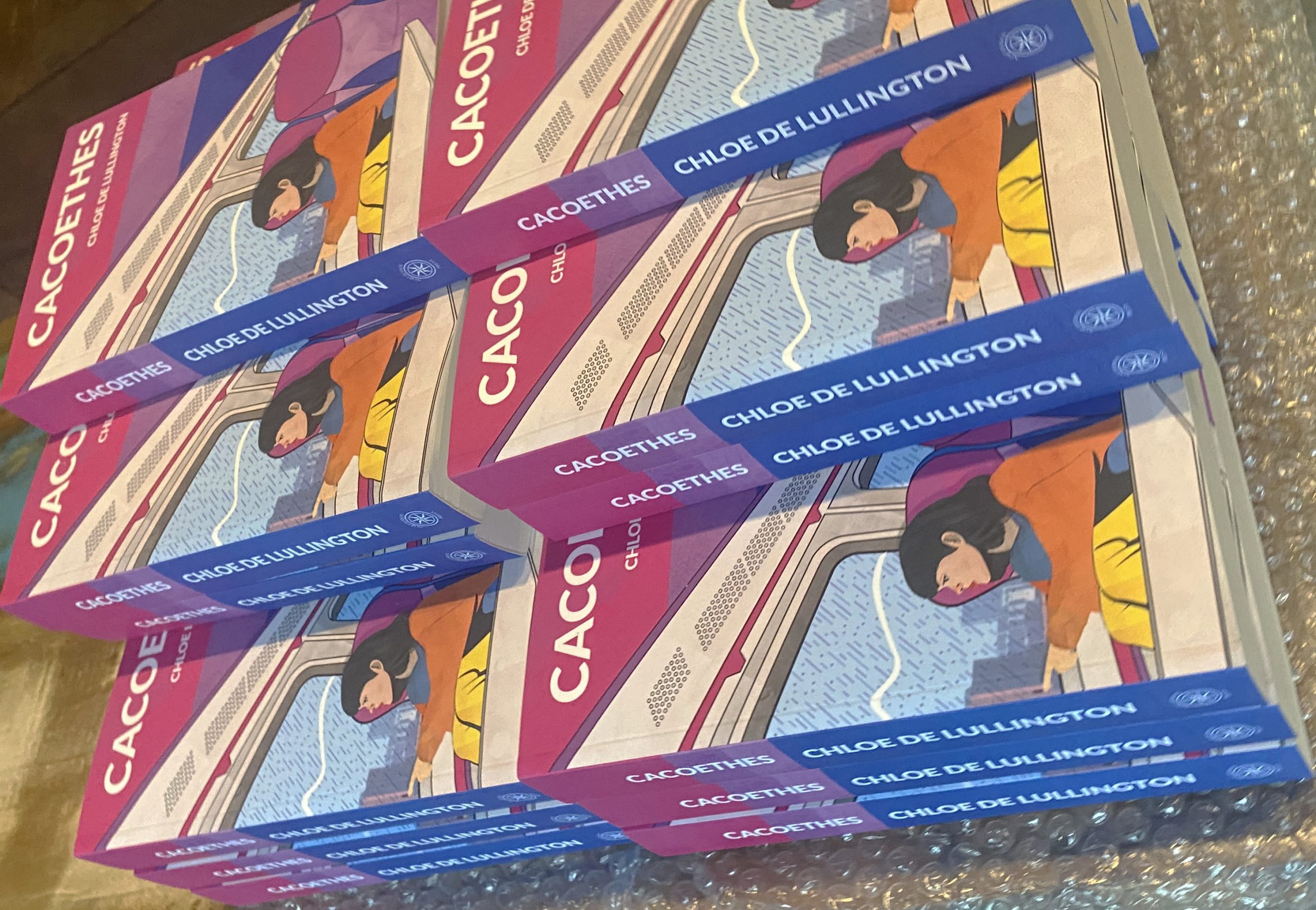
We collared first-time author Chloe De Lullington at her book launch.
Cacoethes is hot off the presses so tell us a little about the story and what led you to tell it.
Cacoethes is a coming-of-age novel that puts the ‘bi’ in ‘Bildungsroman’.* It follows Erin, the first in her family to go to university, as she tries to find her place in the world. With the elusive lure of the ‘Cool Girl’ label always just out of reach, she decides the way to reinvent herself is to throw herself fully into sex positivity, ending up in a deeply uneven BDSM situationship with a man almost twice her age.
When that falls apart, newly convinced of her worldliness and Cool Girl status, she gives sex positivity another go in a slightly different form, and signs up to a sugar baby dating site. Power imbalances of another kind become central to her life as she settles into a conveniently transactional relationship with Hal, an even older man. Everything seems chill for a while – but men always have ulterior motives, and sometimes close female friendships, formed like diamonds in the coal of grubby nightclub toilets and bleary hungover breakfasts, aren’t just friendships. Over time, Erin – always a step behind in her own personal development – is forced to work out who she really wants, and why.
What led me to tell this story is kind of a compulsion. After trying to write it as an angsty serious play (it got to all of two pages before I gave it up), I realised it was ripe for a comedy. One incident really cemented this as better suited to being a humorous version of a potentially quite traumatic story; it’s pretty spoiler-y so I won’t give the whole thing away, but it involved a family photo being shared on a date.
More broadly, I also think we should talk about power dynamics, especially in age gap and heterosexual relationships, and I think we should never stop talking about them, because there will always be teenage girls and men telling them they’re mature for their age. The plot of one of Peter Sellers’ less well-regarded movies, There’s A Girl In My Soup, perfectly encapsulates the 1970 version of this (he plays an ageing, self-obsessed TV chef who chases after nineteen-year-old Goldie Hawn for a solid hour and a half) and fifty-five years later, straight middle-aged men are still pulling the same moves.

I think there should be more bisexual coming-of-age narratives, but I also wanted to pick at some of the threads around putting WLW relationships on a pedestal purely because they remove or decentre men (this is a particular crusade of Erin’s militant feminist friend Molly). After all, real life relationships are seldom so straightforward. On a very basic level, however, I wanted to write something so unavoidably, undeniably, vibrantly bisexual that it couldn’t possibly be mistaken or relegated to a secondary strand of the story or the main character’s identity. Northodox Press really came through with the cover design to achieve this particular ambition of mine!
Is being bi key to Erin’s journey and how?
100%, although she doesn’t realise it until far too far into the story. She’s a classic case of compulsory heterosexuality at the start – her attraction to men is all bundled up with performance within a heteropatriarchal framework which, as a working-class young woman, can’t really be removed from her personal commodification. She’s an object to the older man who introduces her to BDSM – and responds in the aftermath of their relationship by commodifying herself economically, entering a transactional sugar baby agreement with another older man, on (at least superficially) her terms. Throughout all this, she has these incredible female friends she takes for granted at every turn, and because women are socialised to be close, unguarded and vulnerable with one another she doesn’t realise that one of those friendships is a bit different. Ultimately, this is a story of the journey to claiming the bisexual identity.
Some of these topics can be intense or misunderstood, tell us about your approach?
If you tell things with a humorous slant, you can say quite a lot about these thorny topics. Ultimately, I think there’s still this persistent stiff upper lip attitude about British people engaging in any way with sexual content which I think can sometimes be used to artistic advantage; it all depends on how you want to tell it.
I’m not trying to make broad strokes generalisations about bi identities and how they should or should not manifest or form, or who gets to pick or police those identity labels. Cacoethes just takes a pinpointed, intense, three-year deep dive into one version of what contemporary bisexuality and girlhood might look like to one person. In terms of what to tell, one of Erin’s chief characteristics is she overshares to the nth degree – both while drunk in the smoking area and in her intensely personal letters to a penpal – so that meant there weren’t really any places I avoided going, narratively. It also means that, having to now read it out loud to people, I’m feeling slight pangs of regret at not closing off some of those more toe-curling narrative avenues…
So for Erin, wanting to be a “cool girl” at uni: do you need to be bi to be a cool girl?!
Not at all! I wanted to avoid getting into things like tokenism, so Erin’s quest to be a ‘Cool Girl’ is anchored solely in the heterosexual version of ‘cool to the male gaze’, being casual, not getting jealous, doing whatever perhaps ill-advised intimate acts the men in her life want her to do. She’s so blinkered to the notion that she might be bi that early on she chastises Molly – who starts the book batting for both teams before turning “pretty exclusively homosexual these days” – by saying “not everyone has the luxury of bisexuality”. If she’s sexually appealing, it has to be to men, and ideally socially desirable men whose social capital she can use to elevate her status by association, however transactionally.
The same-sex attraction side of things really creeps up on her – I think everyone else in the world sees it before she does – and precipitates a huge amount of soul-searching; her knee-jerk attitudes to some of the queer relationships around her are less about having a problem with them and more about having a problem forcing her straight encounters to fulfil her in the same way she sees in her friends. It’s not that she doesn’t enjoy them, but the ‘Cool Girl’ label doesn’t quite paper over the cracks of yearning for something more rewarding and more meaningful. It takes her a frustratingly long time to ask herself ‘what if the right man isn’t a man’?
Do you keep this authentic to bi experience?
It’s all exaggerated for comic effect – tragic effect too – but there are points of accessibility and relatability because there’s kind of this never-ending question mark over the bisexual identity: are you a confused heterosexual or homosexual person, and since monogamy is still broadly de rigeur, can you ever be happily monogamous? The greedy or indecisive bisexual trope gives me an eye twitch, but Erin is a wide-eyed ingenue going out into the world and trying on a few relationships for size.
In terms of authenticity, I think it comes back to specificity: Erin and her friends needed to feel real, to do justice to being a drop in the ocean of the contemporary queer experience. I don’t for one moment think every bisexual person needs to agonise over their identity, or put themselves in dangerous situations, or justify themselves in any ay, but I also don’t believe it’s a wholly uncommon trajectory or series of circumstances. There are lesbian-leaning and non-binary identities in this, and all of them could be the main character of a whole other novel, but Cacoethes is about one character’s experiences with romance, sex work, and queer awakenings as a white, cis, able-bodied, working-class young woman. There are a lot of privileges that she has, and her sugar baby journey is a choice. Both are factors that contribute to the specificity of the character.
It’s set around the time of your own university experience, ten years ago. Does the moment in time matter to Erin’s experience?
I started writing this when I was nineteen – coming back to edit it, there was a very real danger that my almost thirty-year-old self would come over all ‘how do you do, fellow kids?’ with dialogue changes, so I mostly left that alone. In terms of wider cultural anchoring, there’s actually a small but significant part of the plot that hinges on David Bowie’s death, which obviously could only ever be set at that exact moment in time.
University experience looks a lot different in 2025, due to both the post-covid social landscape and the evisceration of student support grants. I’m not sure a working-class teenager would have such a relatively gilded time at university now; Erin’s friends joke about how she never seems to have money problems before they know she’s got a sugar daddy, but the fact remains this would be a significantly less funny story if her sex work experiences were driven by necessity rather than petty rebound. In a grim way, this is the rose-tinted, escapist version.
Sugar daddy takes me to the themes in play – what was the most challenging part to write?
I really struggle with committing to an ending to things, and it’s hard to discuss this bit without spoiling the final few pages, but on a practical level that was tricky. When I did hit on the ending, though, there was absolutely no other way it could have gone.
The themes were non-negotiable; they’re so tightly entangled together that you couldn’t have the bisexuality without the sugar daddy, which you couldn’t have without the BDSM. It’s definitely made the novel a tricky pitch though; a lot of places wouldn’t touch it with a bargepole. I’ve tried to balance sensitivity with a kind of blasé crassness which I think is beautifully unique to the British youth – some of the funniest and most astute observations I’ve ever heard about love, life, and the universe have vomited forth from unguarded young delinquents, most of whom now have very respectable jobs!
I also struggled with the straight men because there were times where I thought I might have veered too far into heteropatriarchal cartoon villainy. I don’t think I’ve done them too dirty – if anything, I’ve made their charms and allures overly convincing. I hope people can see why Erin would be so susceptible to them, and find it so hard to break out of the dubious comforts they offer – it’s a funny story, until it’s not, and a lot of the points Molly, Alicia and Bo make about Erin’s choices are entirely sensible and come from a place of love.
Does writing bi life feel freeing?
It feels really natural, but that might be because I started writing this ten years ago, and I’ve grown up with this cast of characters even if they haven’t. I think when your life is a rich tapestry of friends and loved ones from all bits of the rainbow flag, diversity is baked into whatever you write because it comes from a place of authenticity. I also feel, sometimes, fiercely protective of bi people in particular because it really seems like everyone has an opinion on the label and its parameters, and performance is always somehow demanded and yet not enough to convince. It’s no wonder Erin spends three years crashing out over it all!
And what do you hope readers take away at the end of the novel?
I’m really interested in people’s thoughts about the ending! I hope the whole book is relatable in places and ‘thank goodness that wasn’t me’ in others, and I hope if a starry-eyed youngster reads perhaps it at the side of her middle-aged boyfriend’s pool or after a night of crying over the fact he won’t text back, she feels held and understood and knows there’s a whole girl squad out there waiting for her if she decides to leave.
I hope it feels real, and I hope people enjoy their time – however frustrating, toe-curling, and crass – with Erin and her girls.