
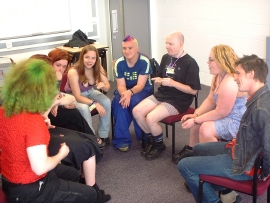
Local bi groups are closing almost every month. Few are springing up to replace them. Memberships are dwindling, while others have suffered burn-out of the people who run them.While individual groups are expected to occasionally wane, this wholesale dwindling is worry ing. It is time to decide what a bi group is for, and how its aims can be met.
People look for a bi group for different reasons,including: wanting to meet other bis wanting support with their sexuality being interested in discussing topics relevant to bisexuality simply wanting to meet people (e.g.people who havejust moved to a new town).
Once they find a group and get to know some people,they may or may not want to stay. Many people make friends at a group, and then meet those friends separately. Once a large number of people decide only to meet elsewhere and not bother coming to the group, if the group hasn’t attracted new people, while retaining a few old-timers to run it, the group will fold. Other people might attend a couple of times, reassure themselves that the group is there if they need it, perhaps if they want to sound off about clueless or homophobic non-bisexuals elsewhere, but then get on with their lives. Others may find that they just don’t enjoy the group activities, wanting more active stuff and less talking – difficult to arrange when you need a venue for people to meet each week.
A local bi group is trying to please a wide range of people from all sorts of back grounds, all ages, men and women, people happy with their sexuality and those just coming to terms with it.They aren’t all going to be interested inthe same workshops,or feel comfortable inthe same sorts of spaces. There’s a limit to how many workshops on Coming Ouf’ someone who is already out wants to go to, yet to newcomers such a discussion is invaluable. Similarly, explicit discussion of sexualactivity attracts many people but puts off just as many others. Young people can feel intimidated or out of place ina group that is mainly older, while older people feel awkward hanging round a group of younger people. Some people come for intellectual discussion while others are intimidated or bored and prefer telling anecdotes, which bores the first lot. Having different groups would help, but given that most towns and cities are lucky to have one bi group running, how can organisers get round these problems?
Publicity is one obvious answer. If people know what a workshop’s topic is ahead of time, they can make a special effort to tum up or to avoid it. Listings magazines and web sites should show the topic if at all possible. A group needs a mixture of topics to avoid the charge of, for example, being obsessed with sex and SM.This problem can arise if the committee are left to organise all the workshops- each week will be whatever they can get someone to run in a hurry. Planning for other people to run workshops is essential. Alternatively the group could focus on its strengths if that works – the London Bi Women’s Group, despite efforts to diversify, mainly attracts university-educated women, aged mid-20s to mid-30s, but is very successful, with membership equalling that of the LBG which has a wide age range and members from all sorts of back grounds,and somehow has to try to please them all. Tempting as it might be to tell them to put up or get lost, a bi group exists for its members and needs to keep them happy, or it might as well fold immediately.
The venue is also important. Groups tend to take what they can get cheaply. Some venues aren’t very attractive, which speeds up the process of people deciding to skip the group and meet their friends in the pub instead. Lots of people don’t want to spend their precious evening in somewhere that reminds them of school,or sends out the message ‘his is where sad losers without a life hang out. No ads can make people return to somewhere they don’t want to be. Having people to greet newcomers is also vital – another job that tends to be dumped on the committee while others gossip.
As I said above,the committee needs to avoid overwork – if they look like they don’t want to be there, you can’t blame members for decidingthey don’t want to be either.
Perhaps the bi group as such has had its day – many young bis are having no problem coming out or finding partners as sexuality is more widely accepted among new generations and gay and straight communities mix in bars and clubs. Also people work longer hours than they used to and can’t spare the time for a bi group each week. Email and the Internet are in many ways better suited to in-depth discussions – not much can be said in an hour,and other activities are already organised separately. Maybe the solution for ailing bi groups is to redefinethem selves as purely social: meeting up in a restaurant once a month (contact a certain person for details) and a quiet pub on one other night a month.And nothing else.
Outside that people could exchange numbers and organise to do whatever interests them. Groups never really did much in the way of support other than what could be accomplished in a friendly chat in the pub anyway.
Maybe I’m just looking for an easy life, having just found myself running a bi group?
HT