
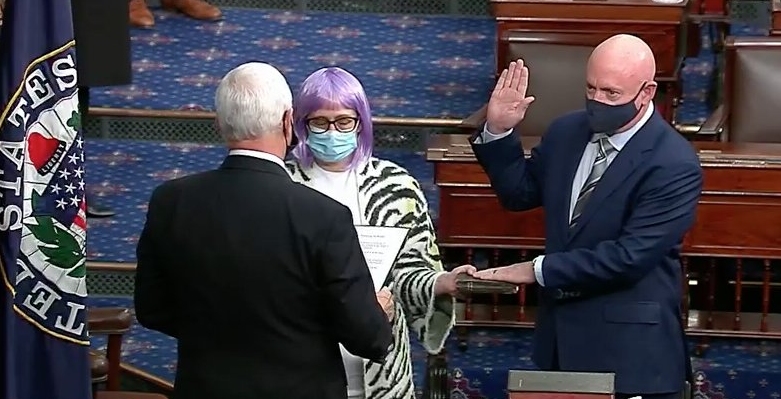
US Senator for Arizona Kyrsten Sinema has found herself at the centre of twitterstorm after twitterstorm this past week.
The Senate’s sole openly bisexual member started out as a radical firebrand. However she won her seat in a state that is closely fought between the Republicans and Democrats, and fought it from the centre ground between the two parties.
Since being elected she has sought to straddle the centre – arguably representing her constituency very well and perhaps the only way to ensure her re-election, by not being too right-wing for most Democrat voters and not being too left-wing for most Republican voters.
It has meant she could collaborate across the party divide while the Republicans were in the majority.
Now though the Senate is famously balanced: 50 Democrats, 50 Republicans, and the Vice President Kamala Harris providing the decisive casting vote whenever a decision is tied in the chamber.
But first it has to be tied, and as a voter who can swing either way on a partisan issue, Kyrsten is not proving a reliable 50th Democrat vote.
Had the opinion poll predicted Democrat landslide taken place last November, her vote would not be so crucial. Polls suggested that the Democrats would have a majority along the lines of 53:47 – which would allow for the odd waverer in each decision.
Ironically the first issue where she seems to have wavered is on LGBT rights. The Equality Act, which incoming President Joe Biden has given enthusiastic backing, may be held up in the Senate by the Republicans using a “filibuster” – carrying on talking pointlessly until the time allocated to the bill has run out and thus preventing it becoming law. Sinema made it clear she is against overruling the filibuster.
Online that provoked former Star Trek star George Takei to lambast the Senator, tweeting “How ironic that, should the GOP filibuster the Equality Act, it will be Krysten Sinema, the first openly bisexual person ever elected to the U.S senate, whose baffling support for the filibuster actually prevents the bill from ever becoming law.”
How ironic that, should the GOP filibuster the Equality Act, it will be Krysten Sinema, the first openly bisexual person ever elected to the U.S senate, whose baffling support for the filibuster actually prevents the bill from ever becoming law.
History is watching, Senator.
— George Takei (@GeorgeTakei) February 26, 2021
That may mean the Equality Act – which would deliver nationwide legal protections in employment and housing akin to those we have in the UK thanks to a mishmash of legislation and European rulings – hits the buffers in the Senate and cannot become law.
That was a fortnight ago; this week she went on to vote down a $15US hourly minimum wage, tweeting her thoughts in a graphic: “I understand what it is like to face tough choices while working to meet your family’s most basic needs. I also know the difference better wages can make, which is why I helped lead Arizona’s effort to pass an indexed minimum wage in 2006, and strongly supported the voter-approved state minimum wage increase in 2016. No person who works full time should live in poverty. Senators in both parties have shown support for raising the federal minimum wage and the Senate should hold an open debate and amendment process on raising the minimum wage, separate from the COVID-focused reconciliation bill. I will keep working with colleagues in both parties to ensure Americans can access good-paying jobs, quality education, and skills training to build more economically secure lives for themselves and their families.”
— Kyrsten Sinema (@SenatorSinema) March 5, 2021
She’s arguing (we think – she famously ignores press requests from outside her state let alone country) that the wage measure should not be tied to COVID relief programmes. However with research showing that LGBT people and especially bi people earn significantly less than gay and straight people, it looks like letting her own queer side down twice in a very short period of time.
Perhaps she is looking to the long term. With the Republicans likely to gain seats in two years, the filibuster may be vital in a few short years for defending LGBT or other human rights.