
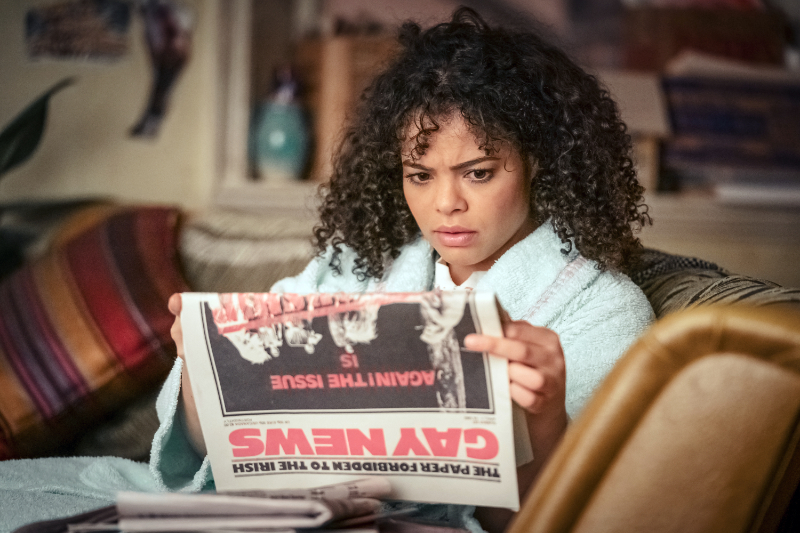
The heavily trailed Channel 4 show It’s A Sin has debuted this weekend.
Set in the 1980s it follows a gaggle of queers as HIV/AIDS arrives in the UK. Across five episodes we travel across the eighties, from the world before AIDS in the UK to the arrival of AZT with its harsh side-effects but promise of likely survival.
For some viewers, maybe now – in what a friend calls “2020 part 2” – is not quite the time to watch that story unfold. Most of us have been too locked away from the people we love for too long just now, living in fear of a virus or dealing with it’s long-term after effects.
However, whenever you are ready for it… it’s beautifully made and with good engaging characters who meet the virus head-on through the era where first no-one knew what it was, then no-one knew how it was spread, then a wave of tabloid-driven hysteria enveloped the nation, and eventually things started to calm down and the development of drugs made some treatment available.
The Bi Bit
Alas… like many Russell T Davies productions, while it’s great at presenting straight and gay people’s lives, it leaves something to be desired in bi representation.
“I’m more like bisexual really,” declares Ritchie. “because then you can fancy anyone in the room. Walk into a party, there’s double the choice.”
His new friend puts his declaration to the test, immediately calling over a boy they have both been admiring and introducing him. “This is Ritchie, he says he’s bisexual so he can have sex with you or me. So what do you want to do, wrestle for him?”
Everything on screen tells us that Ritchie is only interested in the boy and his bisexuality is a paper-thin pretence. It ties in with a host of interviews about the show that have talked about gays and straights, or lesbian-gay-and-trans culture.
Later there’s a fleeting reference to bisexuality in a refutation of the existence of AIDS while its existence and transmission were still little understood:
“AIDS? It’s a money-making scheme for drugs companies. Do you seriously think there’s an illness that only kills gay men? It can calculate that you’re gay and kill you but no-one else? Hmm? What about bisexuals – do they only get sick every other day? They say it’s a cancer, but you can’t catch cancer.”
It all feels so much like COVID denial in 2020. This couldn’t be more 1982, and yet couldn’t be more now.
It’s hard to know where to draw the line on that though. After all, in 1982 where was bisexuality in the public consciousness?
Spoilers
Indeed, away from the bi erasure this is a great show. The gaggle of housemates makes me think of an extended episode of Friends. “The one with… the deadly virus no-one cared about for years”.
A swathe of younger viewers – under 30, say – might not be able to imagine a world where being gay, let alone having AIDS, is deemed adequate reason for someone to lose their job, yet back then it was perfectly normal. I’ve seen many people online shocked at the idea of people being left in isolation wards by staff who wouldn’t go near them.
We meet a cacophony of characters whose lives then crash into an epidemic none of them can see coming – and for a long time none of them even know what to do about it. Sure it’s a story almost entirely about young gay men in London, with little reflection of AIDS in the wider world. Yes our only significant female character seems to have no sexual or romantic life of her own beyond providing a foil for the gay boys and comfort to them when their lives unravel. However, that’s probably a fair reflection of life there and then in the eyes of the people whose lives we are being told a story of.
Jill, a young woman whose role in the story is mainly as friend and carer surrounded by gay men who adore her but depend on her energy, delivers the voice of the narrator at the end. She meets her friend Richie’s mother, and finds out that he had died alone the day before. His mum had insisted he came home from hospital and away from his support circle, but would not stay in his bedroom with him or let his friends visit. Removing the interjections from Valerie, it goes like this:
This is not the story of HIV and AIDS, any more than Queer As Folk told all of the richness of queer life twenty years ago. It’s just a fistful of those stories: a gaggle of young gay men in a corner of London. Perhaps it belongs as a companion to the gays-and-coal-miners film Pride. Where Pride lifted the viewer up, this dashes your hope on grim reality. Both are the truth of the era.
For many of us it’d be best to watch it when the current pandemic is over though.