
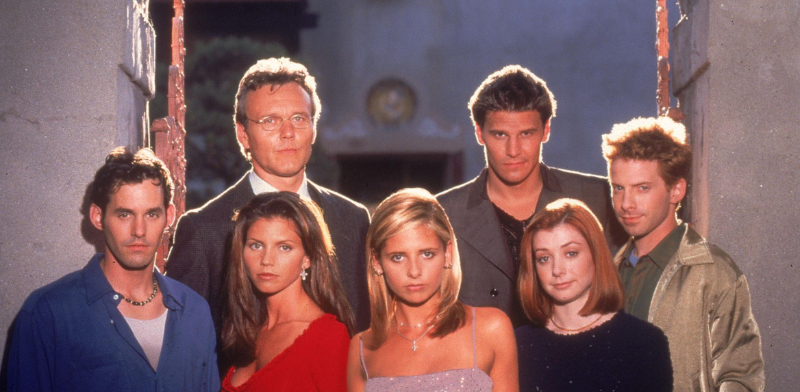
“In every generation there is a chosen one. She alone will stand against the vampires, the demons and the forces of darkness. She is the slayer.”
23 years since Buffy the Vampire Slayer hit our television screens it’s back for terrestrial viewers as Channel 4’s on-demand service All4 and freeview network E4 repeat the whole 144 episode run from series 1 episode 1 through to season 7 episode 22. It’s the story of Buffy Summers (Sarah Michelle Gellar) attempting to live a normal teenage life at Sunnydale High School around her duties as a superpowered vampire hunter. Guided by her Watcher, Giles (Anthony Head) and helped by friends Willow (Alyson Hannigan) and Xander (Nicholas Brendon), Buffy embraces her responsibilities and destiny as The Slayer.
In its day a proudly feminist show with then all-too-rare queer representation – and in its turn inspiring far more queer fanfic and slashfic than the people making it could ever have imagined. We reflected on its importance in BCN back in 2003.
The show had one of TV’s most popular behaviourally bisexual characters in its day – though frustratingly one who never owned the “B” word.
Willow Rosenberg’s plot arc as a character involved three seasons of fancying boys and then four of fancying girls, with a little advance signalling when we met her evil doppleganger from a parallel world who seemed more ostentatiously bisexual.
In an interview with Cult Times magazine in 2000, Alyson Hannigan – who played Willow – reflected on what was happening in the show with Willow’s first relationship with another woman appearing on screen:
“It’s just two girls who are in love. It’s no different than when Willow fell for Oz really.”
“Right now, she is in love with Tara, who’s female, but I don’t know whether it means Willow’s gay. In fact – that’s what I want to know. I asked Joss [Whedon, the screenwriter behind Buffy] and he said ‘Well, she’s open to new experiences.’ But if it turns out that she is gay […] if Willow knows what she’s attracted to and didn’t act on it till college because she didn’t feel comfortable with it, who am I to go against that?”


Read more about bis on TV, film and in the papers in our bimediawatch section.